GTC 2026 roadmap: Rubin Ultra, LP35, Feynman, LP40, Rosa
Watch the original video · 139 min
This segment runs from 1:34:40 to 1:46:32. It covers three things: Vera Rubin’s production status, the multi-year chip and rack roadmap through Feynman, and the Omniverse DSX platform for designing whole AI factories, plus a short mention of a computer for space. Watch it if you plan data-center builds two or three years out, or if you supply copper, optics or power gear to the AI build-out. The hardware already shipping is covered in our Vera Rubin platform notes.
Key takeaways
- Vera Rubin is in full production alongside GB300. Jensen says every major storage vendor is joining the BlueField-4 ecosystem (1:34:45).
- Stage claim: 350x more tokens per second from a 1 GW factory in two years, from 2 million to 700 million (1:35:59). We did not find this figure in NVIDIA’s press releases.
- Rubin Ultra has taped out. A new LP35 chip adds NVIDIA’s NVFP4 format to the Groq line (1:37:33).
- Feynman brings LP40, the Rosa CPU, BlueField-5 and ConnectX-10 (1:38:08). It is the first generation with both copper and CPO scale-up in Kyber.
- DSX targets the power wasted between components. Jensen estimates a 2x gain in token throughput is available from better whole-factory design and operation (1:41:52).
Chapter notes
1:34:40 – 1:36:28 Vera Rubin in production, and the 350x figure
The segment opens with production status. Vera Rubin racks are being built in parallel with GB300. The Vera CPU is selling well because agents need fast CPUs for tool calls. The BlueField-4 storage platform has signed up, in Jensen’s words, all of the storage industry, because AI agents rather than people will now hammer storage with KV cache and vector lookups.
Then comes the headline number. In a 1 GW factory, two years of architecture change takes output from 2 million to 700 million tokens per second, a 350x jump. Moore’s law alone would have given only a few times more transistors, FLOPS and bandwidth. The comparison on the slide is x86 + Hopper against Vera Rubin with Groq LPX. Read it as best case: it combines a new GPU generation, a new precision format, rack-scale NVLink, the Groq accelerator and new serving software, and it likely assumes a workload that favors all of them. It is useful as a measure of how much of NVIDIA’s gain now comes from system design rather than silicon.
1:36:28 – 1:40:06 The roadmap slide
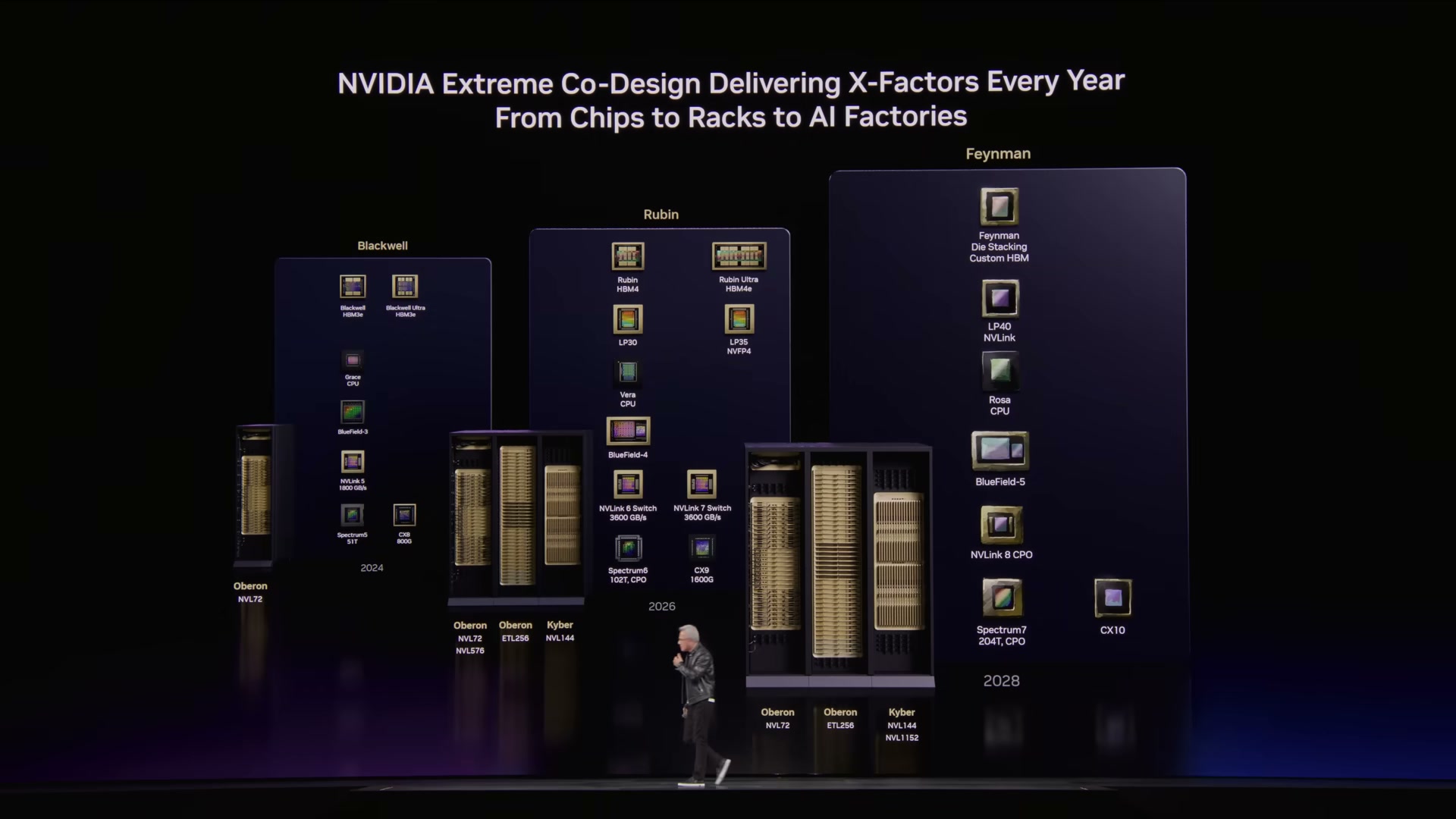
The slide is organized by generation, and each column contains both chips and the racks they ship in. Three things stand out.
Backward compatibility is a deliberate promise. The Oberon rack that housed Blackwell NVL72 continues into the Rubin generation. Jensen says buyers who change nothing can keep running Oberon with copper NVLink. That lowers the risk for data centers already built around NVL72 power and cooling.
Groq is now a roadmap line, not a one-off. LP30 ships with Vera Rubin. LP35 follows in the Rubin Ultra timeframe and adds NVFP4, so the LPU and GPU can share a number format. LP40 in the Feynman generation is labeled “NVLink”, which suggests the LPU joins NVIDIA’s own scale-up fabric rather than talking over Ethernet. That last reading is our inference from the slide label. Jensen did not spell it out.
Copper and optics both stay. Jensen addresses the debate head-on (1:39:11). Copper still matters. NVIDIA will also scale up and scale out over optics. Oberon with optical scale-up reaches NVL576. In Feynman, Kyber comes in both copper and CPO versions, the first time NVIDIA offers both for scale-up. His closing request to suppliers is capacity: more copper, more optical components, more CPO. For investors in the cabling and optics supply chain, that is the most direct line of the segment.
On timing, the slide places the Feynman column at 2028. Jensen closes by restating an annual rhythm: a new architecture every year.
1:40:06 – 1:45:40 Omniverse DSX: designing the whole factory
NVIDIA now calls itself an AI factory company, and this section explains what that means in practice. Jensen’s point is that the components of an AI factory — chips, racks, power, cooling, networking, the grid connection — used to meet for the first time inside the finished building. Every mismatch costs energy. DSX moves that meeting into a digital twin built on Omniverse.
The video at 1:42:18 walks through the pieces:
- DSX Sim for physical, electrical, thermal and network simulation;
- DSX Exchange for the factory’s operating data;
- DSX Flex for dynamic, secure power management with the grid;
- DSX Max-Q for squeezing maximum token throughput out of a fixed power budget.
Partners named in the flow include PTC Windchill, Dassault 3DEXPERIENCE, Jacobs, Siemens STAR-CCM+, Cadence Reality, ETAP and Procore. Agents from Phaedra and Emerald AI handle cooling, electrical and grid signals once the site is live.
NVIDIA’s official release adds harder numbers than the keynote. It says DSX Max-Q enables 30% more AI infrastructure inside a fixed-power data center, and that DSX Flex can unlock 100 GW of stranded grid power. On stage, Jensen only offers a rough estimate that 2x is available. The gap between “2x” on stage and “30%” in the release is worth noting if you are modeling it.
1:45:40 – 1:46:32 Vera Rubin Space-1
A brief closing note. NVIDIA’s Thor platform is radiation-certified and already flying on satellites. NVIDIA is working with partners on Vera Rubin Space-1 for data centers in orbit. Jensen names the core problem: in space there is no conduction or convection to carry heat away, only radiation. NVIDIA’s space computing release says the module will be available at a later date. No dates, specs or partners are given on stage, so treat this as a direction rather than a product.
What changed since GTC 2025
GTC 2025’s roadmap said: Blackwell Ultra in H2 2025, Vera Rubin in H2 2026, Rubin Ultra in H2 2027, and Feynman after that. It introduced Kyber as the Rubin Ultra rack and committed to an annual cadence. It also announced silicon-photonics Spectrum-X and Quantum-X switches, though only for scale-out.
| Item | GTC 2025 | GTC 2026 |
|---|---|---|
| Vera Rubin | H2 2026 | In full production in March 2026 |
| Rubin Ultra | H2 2027, Kyber rack | Taped out; Kyber node shown; NVL144 per Kyber rack, NVL576 via optical Oberon |
| Feynman | Named as the next architecture, few details | Full lineup: LP40, Rosa CPU, BlueField-5, CX10, NVLink 8 CPO, Spectrum-7; slide says 2028 |
| Groq / LPU | Not mentioned | LP30 now, LP35 next, LP40 with Feynman |
| Optics | CPO for scale-out switches | CPO extended to NVLink scale-up in the Feynman Kyber rack |
| AI factory design | Omniverse blueprint for AI factories introduced | DSX with Sim, Exchange, Flex, Max-Q and a Vera Rubin reference design |
| Space | Not mentioned | Vera Rubin Space-1 announced as in development |
The schedule has held so far: Vera Rubin arrived on or ahead of the date set a year earlier. The bigger change is how crowded the roadmap has become. In 2025 it was a GPU story with a CPU and switches. In 2026 every generation also carries an LPU, a storage processor and two scale-up options.
Sources: GTC 2025 live updates, GTC 2026 live updates, DSX reference design release.
Skip list
- 1:39:53 – 1:40:06 Jensen checks whether he missed anything. No content.
- 1:42:18 – 1:44:54 The DSX promotional video. It lists partners and tools; the four DSX components are summarized above.
- 1:44:54 – 1:45:40 Thank-you to the DSX partner ecosystem.
Glossary
- Tape-out — the point when a chip design is finished and sent to the foundry for manufacturing.
- LP35 / LP40 — NVIDIA’s next Groq-derived LPU chips; LP35 adds NVFP4, LP40 arrives with Feynman.
- Rosa — the CPU planned for the Feynman generation, named after physicist Rosalyn Yalow; it succeeds Vera.
- Scale-up vs. scale-out — scale-up links GPUs into one large logical GPU (NVLink); scale-out links many such systems over a network (Ethernet or InfiniBand).
- Digital twin — a live simulation of a physical facility, used to design it before building and to tune it while it runs.
- Max-Q — NVIDIA’s term for running a power-capped system at its most efficient point; in DSX, software that raises token throughput within a fixed power budget.
FAQ
What comes after Vera Rubin in NVIDIA's roadmap?
Rubin Ultra comes next, in the new Kyber rack, along with a new Groq-derived LP35 chip that adds NVFP4 support. After that comes Feynman, with die-stacked custom HBM, the LP40 LPU, a new CPU called Rosa, BlueField-5 and ConnectX-10. The roadmap slide labels the Feynman generation 2028.
Will NVIDIA use copper or optics for NVLink scale-up?
Both. Jensen says Oberon racks keep copper NVLink, Kyber adds 144-GPU copper scale-up, and optical scale-up reaches NVL576. In the Feynman generation Kyber gets both copper and co-packaged optics versions.
What is NVIDIA DSX?
DSX is NVIDIA's Omniverse-based blueprint for designing and running gigawatt-scale AI factories as digital twins. It has four parts: DSX Sim for physics, power, cooling and network simulation; DSX Exchange for operating data; DSX Flex for grid power management; and DSX Max-Q for maximizing token throughput under a power cap.
What is Vera Rubin Space-1?
It is a Vera Rubin-based computer NVIDIA is developing with partners for data centers in orbit. Jensen notes that space allows cooling only by radiation, which is the main engineering problem. NVIDIA says the module will be available at a later date.