GTC 2026 Nemotron Coalition and NVIDIA's six open model families
Watch the original video · 139 min
This segment runs from about 1:56:45 to 2:05:26 of the GTC 2026 keynote. Jensen Huang lays out NVIDIA’s six open model families, commits to shipping a new generation of each, and announces the Nemotron Coalition, a group of AI labs that will co-build the base model for Nemotron 4. It is worth watching if you choose models for production, track the open-weight versus closed-model contest, or want to understand why a chip company spends heavily on models it gives away.
Key takeaways
- Six families, one pitch. Nemotron, Cosmos, GR00T, Alpamayo, BioNeMo and Earth-2 cover language, world models, robots, cars, biology and climate (1:57:10).
- A versioning promise. Jensen says Nemotron 3 will be followed by Nemotron 4, and that every family will keep getting new generations (1:59:30).
- The Nemotron Coalition launches with eight labs. Black Forest Labs, Cursor, LangChain, Mistral AI, Perplexity, Reflection AI, Sarvam and Thinking Machines Lab are named on stage and in the release (2:01:57).
- Mistral and NVIDIA co-develop the first coalition model. It is trained on DGX Cloud and becomes the base of Nemotron 4, per the official release.
- Tokens as a job perk. Jensen predicts engineers will receive annual token budgets on top of salary (2:03:43).
Chapter notes
1:56:45 – 1:58:00 Why companies need their own models
Jensen bridges from the NemoClaw segment by saying the most important part of a custom agent is a custom model. That is the commercial logic behind NVIDIA’s open-model program. A company that fine-tunes an open model still needs GPUs to train and serve it, and NVIDIA’s models are tuned for NVIDIA formats such as NVFP4.
He then names the six families and claims NVIDIA is at the frontier in each. The supporting video says there are close to three million open models across language, vision, biology and physics, and calls NVIDIA one of the largest contributors to open-source AI. The three-million figure comes from the keynote video and was not found in the official releases.
1:58:00 – 1:59:15 The six families in one reel
The reel gives each family one line. Nemotron covers language reasoning, vision understanding, retrieval, safety and speech. Cosmos generates and understands physical worlds. Alpamayo is pitched as the first autonomous-driving AI that reasons about its decisions. GR00T is the general-purpose robot foundation model. BioNeMo targets biology, chemistry and molecular design. Earth-2 handles AI-physics weather and climate forecasting.
The reel also stresses that NVIDIA releases training data, recipes and frameworks, not just weights. That matters for regulated buyers who need to explain where a model’s behavior comes from, and it is a real difference from open-weight releases that ship no data.
1:59:15 – 2:00:43 Cadence, leaderboards and Nemotron 3 Ultra
Jensen’s argument for trusting NVIDIA’s models is continuity: he says NVIDIA will not abandon them, with Nemotron 4 after Nemotron 3, Cosmos 2 after Cosmos 1, and GR00T in its second generation. Customers betting on an open model care less about one benchmark win than about whether the vendor will still be shipping updates in two years.
He then shows a leaderboard slide with Nemotron 3 running inside OpenClaw, claims it sits among the top three models, and introduces Nemotron 3 Ultra as a base model for fine-tuning. Jensen called it the best base model ever built; that superlative is his and not a measured claim. The official release is more specific: Nemotron 3 Ultra delivers 5x throughput efficiency using the NVFP4 format on Blackwell. Note that the stage version numbering for Cosmos does not match the release, which announced Cosmos 3 the same day.
2:00:43 – 2:02:37 The Nemotron Coalition
Jensen frames the coalition around sovereign AI: countries and industries need models specialized for their domain and language, and no single model serves everyone. He says NVIDIA has invested billions of dollars in AI infrastructure for this work; that figure was not quantified in the official release.
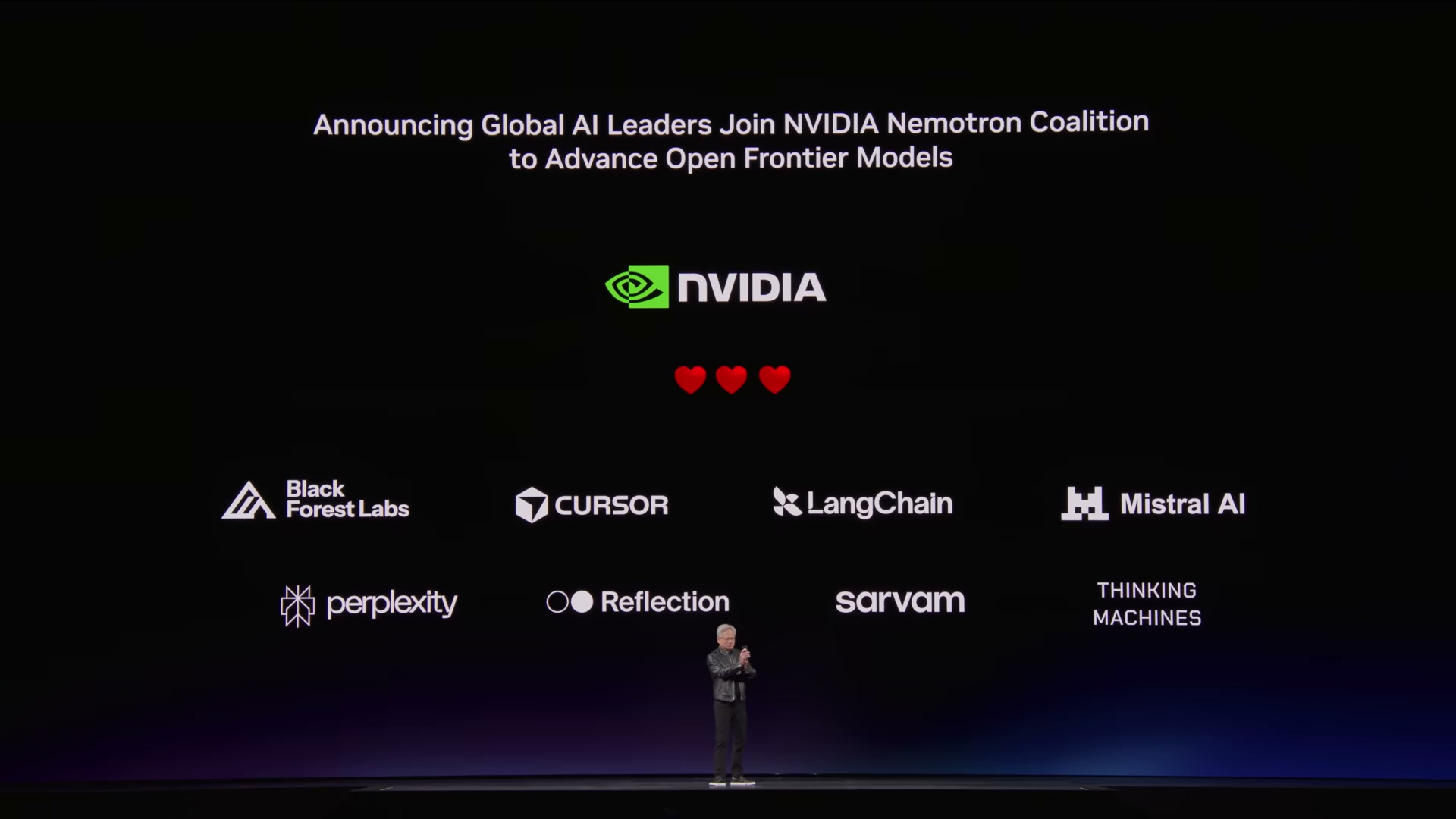
The roster is more interesting than it looks. Mistral AI brings frontier pre-training and co-develops the base model. Cursor brings real-world coding evaluation sets. LangChain brings agent tool-use and observability. Black Forest Labs adds multimodal image and video work. Perplexity contributes experience serving models at scale. Reflection AI and Sarvam represent the “open and sovereign” camp, in the U.S. and India respectively. Thinking Machines Lab contributes data collaboration.
The structure resembles a consortium more than a joint venture. Members keep building their own models; they contribute data and evaluations to one shared base model. For NVIDIA, the coalition spreads the data and evaluation cost of a frontier-scale open model across partners while keeping training on DGX Cloud. For members, it is a cheaper path to a strong open base they can specialize.
Jensen said LangChain has billions of downloads. The official release quotes LangChain’s CEO citing over 100 million monthly downloads, which is the verifiable figure.
2:02:37 – 2:05:26 Agent strategy and token budgets
Jensen returns to agents. He says coalition members and many enterprise software firms are integrating the NemoClaw reference design, the NVIDIA Agent Toolkit and the open models. He predicts enterprise IT will grow from a roughly $2 trillion industry into a multi-trillion-dollar one, because vendors will rent specialized agents rather than sell tools; that forecast is not in the official releases.
The memorable line is about compensation. Jensen imagines giving engineers an annual token budget worth about half their salary on top of base pay, on the theory that it would make them far more productive, and predicts that the token allowance attached to a role becomes a Silicon Valley hiring question. Treat the half-salary and 10x-productivity numbers as illustration rather than policy. The economic idea behind it is covered on the token economics page.
What changed since GTC 2025
At GTC 2025, NVIDIA’s open models were a looser set of announcements. It launched Llama Nemotron reasoning models in Nano, Super and Ultra sizes, built by post-training Meta’s Llama on DGX Cloud. It announced Isaac GR00T N1, billed as the first open humanoid foundation model, and released new Cosmos world foundation models. Alpamayo and the “six families” framing did not appear.
A year later, the changes are structural:
- From Llama-based to NVIDIA-owned base models. In 2025 the flagship language models were Llama derivatives. In 2026 NVIDIA ships Nemotron 3 under its own name and recruits a coalition, led technically by Mistral, to build the Nemotron 4 base. That reduces NVIDIA’s dependence on any one outside model vendor.
- Version jumps across the board. GR00T N1 became N1.7 with commercial licensing, with N2 previewed for year-end. Cosmos moved to Cosmos 3. Alpamayo reached 1.5.
- A formal partner structure. 2025 had customer logos. 2026 has named coalition members with defined contributions.
What GTC 2025 promised and 2026 delivered: the Ultra-size reasoning model promised in 2025 now exists as Nemotron 3 Ultra, and GR00T moved from a research release to commercially licensed deployment.
Skip list
- 1:58:00 – 1:59:10: the six-family sizzle reel. The chapter notes above cover each line it delivers.
- 2:03:10 – 2:03:35: renaissance interlude with no new information.
Glossary
- Nemotron — NVIDIA’s open language and multimodal model family for agents, covering reasoning, vision, speech, retrieval and safety.
- Nemotron Coalition — A group of AI labs announced at GTC 2026 that contributes data, evaluations and expertise to a shared open base model for Nemotron 4.
- Base model — A pre-trained model before task-specific post-training; companies fine-tune it into their own assistant or agent.
- NVFP4 — NVIDIA’s 4-bit floating-point format on Blackwell GPUs, used to raise inference throughput.
- Sovereign AI — Models built so a country or region controls the data, language coverage and deployment of its AI.
- DGX Cloud — NVIDIA’s hosted GPU cloud service, where the coalition base model is trained.
For the robotics and driving models in this lineup, see physical AI, robotaxis and robotics. The full chapter map is in the keynote notes.
FAQ
Who are the founding members of the Nemotron Coalition?
NVIDIA's March 16, 2026 release lists eight inaugural members besides NVIDIA - Black Forest Labs, Cursor, LangChain, Mistral AI, Perplexity, Reflection AI, Sarvam and Thinking Machines Lab.
What will the Nemotron Coalition build first?
A base model codeveloped by Mistral AI and NVIDIA, trained on NVIDIA DGX Cloud. Other members contribute data, evaluations and domain expertise for post-training, and the result will underpin the Nemotron 4 family.
What are NVIDIA's six open model families?
Nemotron for language and agents, Cosmos for world models, Isaac GR00T for robotics, Alpamayo for autonomous driving, BioNeMo for biology and chemistry, and Earth-2 for weather and climate.
Which new models did NVIDIA announce alongside the coalition?
Nemotron 3 Ultra, Omni and VoiceChat; Cosmos 3; Isaac GR00T N1.7 with a preview of GR00T N2; Alpamayo 1.5; and the Proteina-Complexa protein-design model under BioNeMo.